
Dishwasher Not Draining? Causes, Safe Fixes and When to Call a Technician
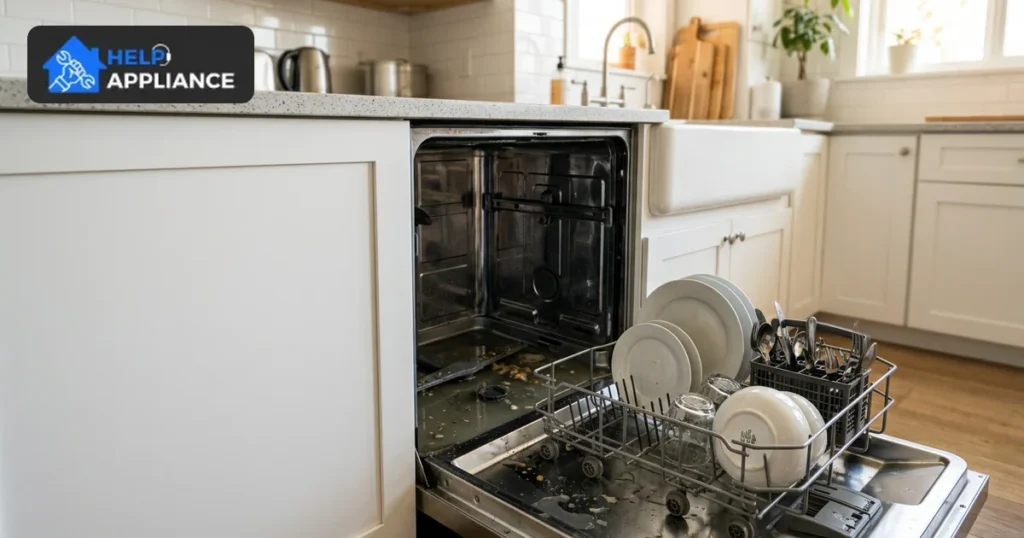
Quick Answer: A dishwasher not draining is usually caused by a clogged filter, a blocked garbage disposal inlet or a kinked drain hose. Bail out the water, clean the filter, run the disposal and straighten the hose. If water still sits in the tub after those checks, the drain pump or check valve likely needs a technician.
Reviewed by the Help Appliance repair team, Woodbridge, Virginia. Last updated December 2026.
You open the door after a full cycle and find a pool of gray water sitting where clean dishes should be. A dishwasher not draining is one of the most common calls we get in Woodbridge and across Northern Virginia, and the good news is that about half of these calls come down to something a homeowner can check in fifteen minutes with a towel and a screwdriver.
Our guide walks you through every cause in the order a technician checks them, from the filter you can rinse in the sink to the drain pump that needs a professional. You will also find brand error codes, a quick symptom table, and a clear line for when to stop and book a repair.
Why Is My Dishwasher Not Draining? The Short Answer
Most dishwashers stop draining because of a clogged filter, a blocked disposal inlet or a kinked drain hose.
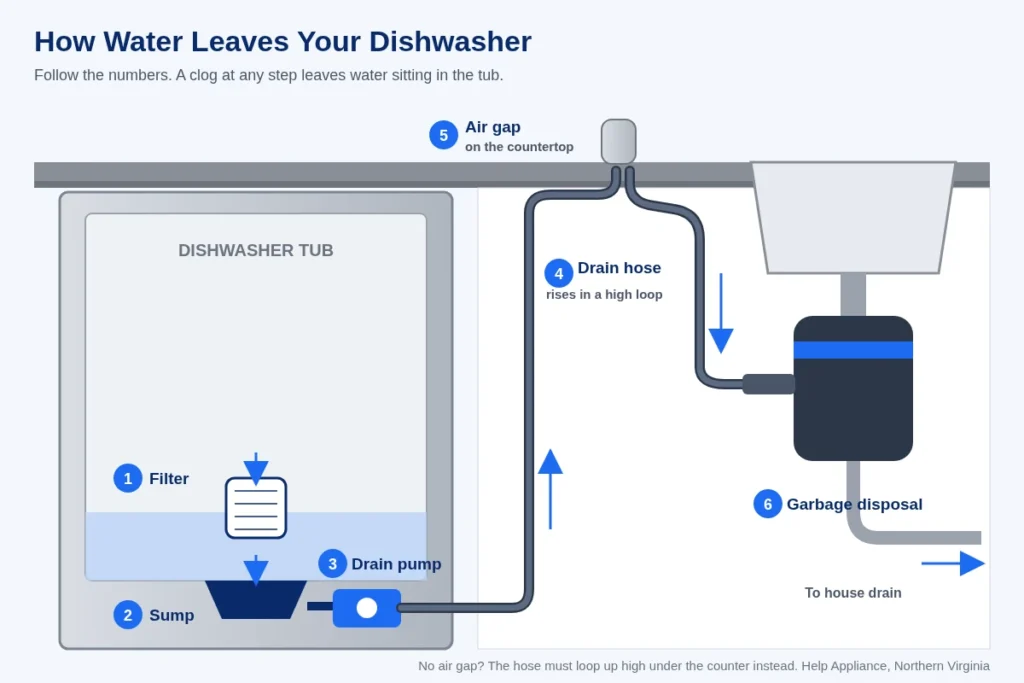
Water leaves a dishwasher through a simple path. It falls through the filter into the sump, the drain pump pushes it up through the drain hose, and the hose empties into your garbage disposal, an air gap, or the sink drain. If any point on that path is blocked or broken, the water stays in the tub.
In our experience, the causes break down roughly like this:
- A clogged filter or sump (the most common by far)
- A blocked garbage disposal inlet or a new disposal with the knockout plug still in place
- A kinked, crushed or clogged drain hose
- A clogged air gap on the countertop
- A failed or jammed drain pump
- A stuck check valve
- A control, door latch or float switch fault that stops the drain cycle from running
The first four are usually safe for you to check. The last three normally need a technician with a meter and the right parts.
Before You Start: Five Safety Steps
Take these steps before you touch anything inside the tub. They protect you and the machine.
- Cut the power. Switch off the breaker for the dishwasher or unplug it from the outlet under the sink. Turning the machine off at the panel is not enough.
- Let hot water cool. Water at the end of a cycle can be hot enough to scald. Give it twenty minutes.
- Bail out the water. Use a cup and a bowl, then soak up the last of it with an old towel or a sponge. A wet and dry shop vacuum works well too.
- Protect your floor. Lay towels in front of the door. Some water always escapes when you remove the filter.
- Never use chemical drain cleaner. Products made for sink drains can damage the pump seal, the plastic sump and the hoses. They also make the job dangerous for the technician who comes after you.
Step 1: Clean the Dishwasher Filter
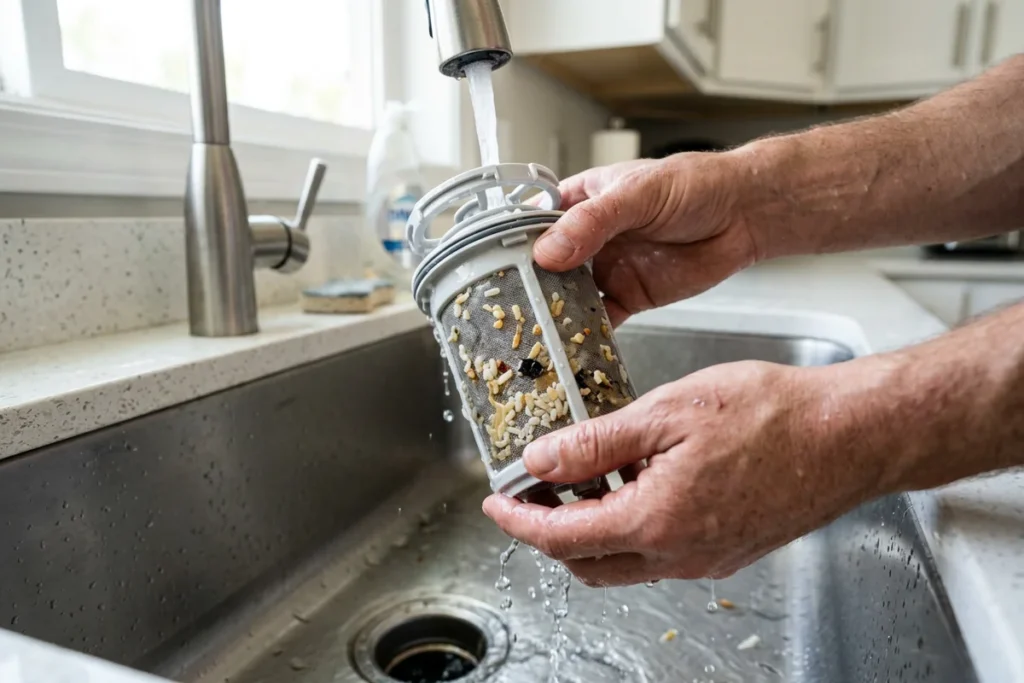
Most dishwashers sold in the last ten years use a manual filter that you are expected to clean yourself. Many homeowners never knew it was there. Once it is packed with food, grease and labels from jars, water simply cannot reach the pump.
How to clean it:
- Pull out the lower rack completely.
- Find the round filter cylinder in the floor of the tub, usually at the back or center.
- Turn it a quarter turn counterclockwise and lift it out. On many models a flat mesh screen comes out with it.
- Rinse both parts under warm water. Use a soft brush or an old toothbrush and a drop of dish soap on greasy buildup.
- Look into the opening where the filter sat. Remove any glass, bone, fruit pits or bits of plastic you can see.
- Put the filter back and turn it until it locks. A loose filter lets debris straight into the pump.
How often to do it: Once a month for an average household, or every two weeks if you rarely rinse plates before loading them.
If the tub drains normally after this, you have found the problem. If water is still sitting there, keep going.
Step 2: Check the Garbage Disposal Connection
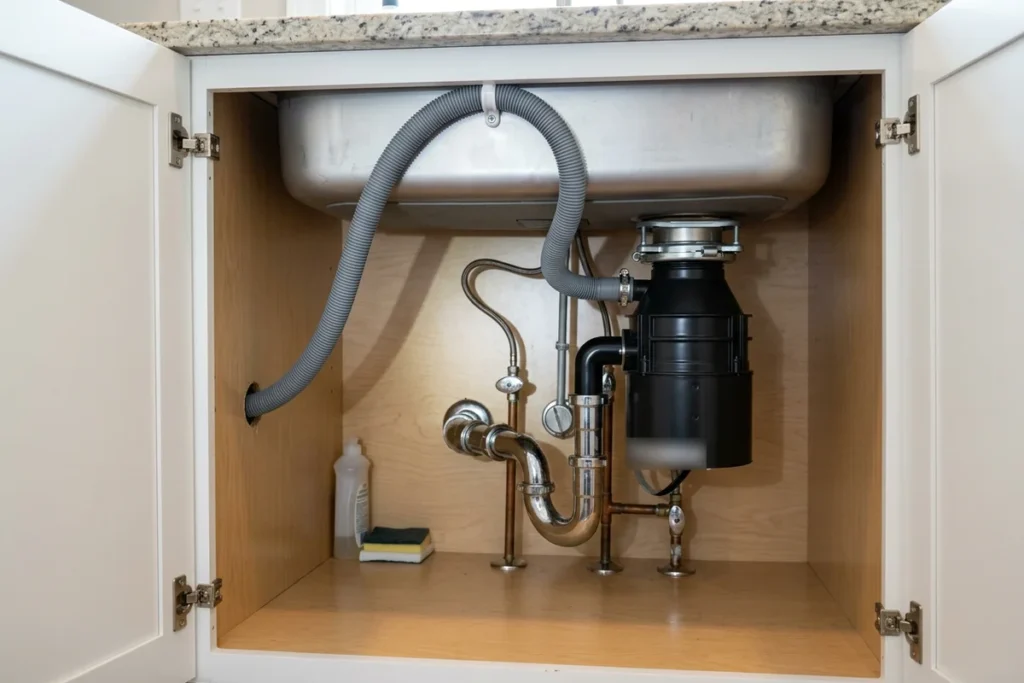
On most homes in Northern Virginia, the dishwasher drain hose connects to the side of the garbage disposal. This creates two very common problems.
The disposal is full. If the disposal chamber is packed with food, the dishwasher has nowhere to send its water. Run the disposal with cold water for thirty seconds, then run a short rinse cycle on the dishwasher and see if it drains.
The knockout plug was never removed. Every new garbage disposal ships with a small plastic plug inside the dishwasher inlet. It has to be knocked out with a screwdriver and a hammer before the dishwasher hose is connected. If your dishwasher stopped draining right after a new disposal was installed, this is almost certainly the cause. It is one of the most frequent findings on installation callbacks, and it is a five minute fix for anyone comfortable working under a sink with the power off.
Not Sure What Is Wrong?
Help Appliance serves Woodbridge and Northern Virginia. Diagnostic $65 to $125 by area, waived when you approve the repair. You get a written report before any work.
📞 Call (571) 535 5759Get a Repair TimeStep 3: Inspect the Drain Hose
The drain hose is a ribbed, flexible tube that runs from the dishwasher pump to the sink plumbing. Three things go wrong with it.
Kinks and crushing. When a dishwasher is pushed back into its cabinet, the hose can fold behind it. Storage bins under the sink can also crush it. Look along the full length you can reach under the sink and straighten any sharp bends.
Clogs. Grease and food can harden inside the hose, especially at the end that connects to the disposal. With the power off, loosen the clamp at the disposal end, place a bowl underneath, and pull the hose free. Run water through it or push a straightened coat hanger gently through to check for blockage. Reconnect it firmly so it does not leak.
No high loop. The drain hose must rise up to the underside of the counter before it drops down to the disposal. This high loop stops dirty sink water from flowing back into the dishwasher. Without it, you may find water sitting in the tub even when the pump works perfectly. If your hose runs flat along the cabinet floor, fasten it up high with a strap or a zip tie.
Step 4: Clear the Air Gap
Some homes, particularly where local code requires it, have a small chrome or plastic cylinder on the countertop or sink edge beside the faucet. That is an air gap. It does the same job as the high loop.
If water spurts out of the air gap while the dishwasher drains, it is clogged. Pull off the decorative cover, unscrew the inner cap, and clean out the debris with a small brush or a pipe cleaner. Rinse it and put it back. This takes two minutes and fixes a surprising number of slow drains.
Step 5: Run the Right Cycle and Use the Right Detergent
Sometimes the dishwasher is not broken at all. It just has not finished.
Interrupted cycle. If the power flickered, the door was opened, or someone pressed cancel, the machine may have stopped before the final drain. Press Cancel or Drain (on many models you hold Start or Cancel for three seconds) and wait two minutes with the door closed. Most dishwashers will run a drain on their own.
Wrong detergent or too much of it. Regular dish soap, or too much powder, creates a thick foam that the pump cannot move. If you see suds in the tub, this is your cause. Scoop out the foam, pour in a cup of cold water with a few spoonfuls of vegetable oil to break it down, and run a rinse cycle. Use only detergent made for automatic dishwashers.
Rinse aid and hard water. Northern Virginia water is moderately hard in many areas, which leaves mineral scale inside the sump over time. A monthly cleaning cycle with a dishwasher cleaner tablet or a cup of white vinegar in an upright cup on the top rack helps keep the drain path clear.
Step 6: Listen to the Drain Pump
If the filter, hose, disposal and air gap are all clear, the problem is likely inside the machine. Turn the power back on and start a Drain or Cancel cycle. Put your ear close to the bottom of the door.
You hear a steady hum but no water moves. The pump motor is getting power but the impeller cannot turn. Something hard may be jammed in it, such as a piece of glass, a cherry pit or a small bone. This often needs the pump cover removed, which on some models means pulling the dishwasher out of the cabinet.
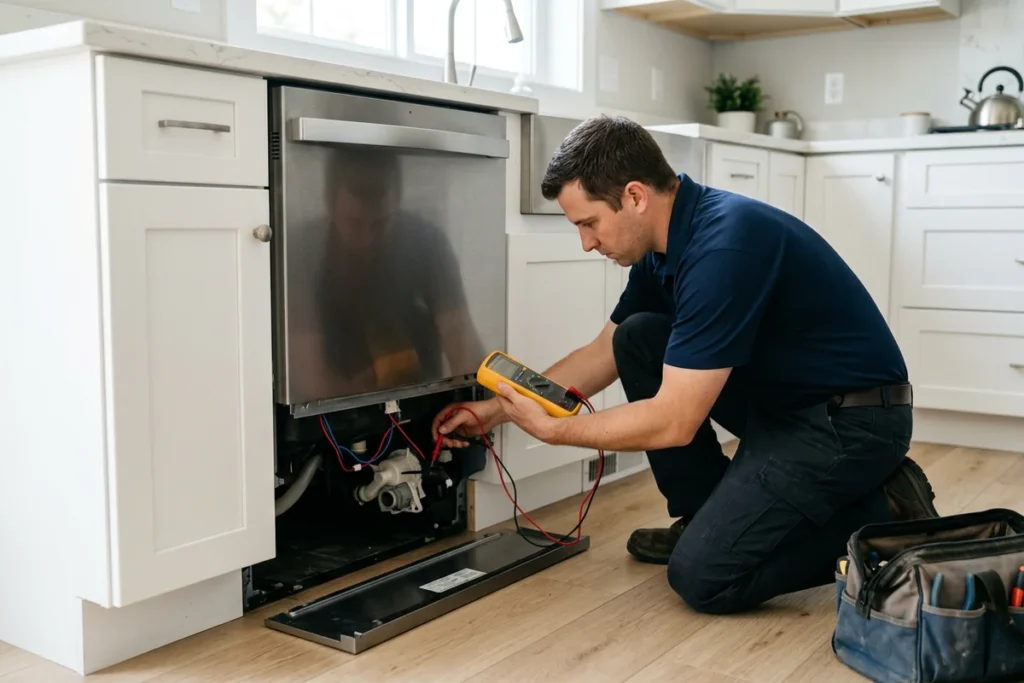
You hear nothing at all. The pump may have failed, or the control board is not sending it power. A technician will test the pump winding and the voltage at the connector with a meter. Swapping parts without testing them is the most expensive way to fix a dishwasher.
You hear a grinding or rattling sound. The impeller is likely damaged or the pump motor bearing is worn. The pump usually needs replacing.
At this point, the repair moves from cleaning to diagnosing electrical and mechanical parts. Unless you have experience with a multimeter and appliance wiring, this is the right time to call a professional.
Step 7: The Check Valve and Float Switch
Check valve. Many dishwashers have a one way flap or ball valve at the pump outlet. It lets water leave but stops it from flowing back. When it sticks closed, the pump runs but the water stays. When it sticks open, dirty water drifts back into the tub after the cycle ends.
Float switch. The small dome in the front corner of the tub floor rises with the water level. If it sticks in the up position, some dishwashers stop the cycle or keep running the drain pump. If it sticks down, the machine can overfill. Lift it gently to make sure it moves freely.
Both parts sit close to the pump and the wiring, so we recommend a technician for anything beyond a visual check.
Why Is My Dishwasher Not Draining Completely?
A dishwasher not draining completely usually has a partly clogged filter or hose, while a full tub points to a blocked disposal, crushed hose or failed pump. The amount of water left behind tells you a lot.
What you see | Most likely cause | Can you fix it yourself? |
|---|---|---|
A cup or less of clean water in the sump | Normal. Most dishwashers keep a little water to protect the seals | No action needed |
Water covers the filter area, a few inches deep | Clogged filter or partially blocked hose | Usually yes |
Full tub after every cycle | Disposal knockout plug, crushed hose or failed pump | Plug and hose yes, pump no |
Water spits from the countertop air gap | Clogged air gap | Yes |
Foam and suds in the tub | Wrong detergent or too much | Yes |
Pump hums but nothing drains | Jammed impeller or stuck check valve | Usually a technician |
No sound at all during drain | Failed pump or control fault | Technician |
Error code on the display | Depends on brand, see the next section | Start with the filter, then call |
Brand Specific Help: Error Codes and Quirks
Every major brand flags a drain problem in its own way. Here are the ones we see most often in Northern Virginia homes. Always check the filter first, because a clogged filter triggers almost all of these codes.
Bosch: E24 and E25 Codes
Bosch shows E24 when the drain hose or the drain path is blocked and E25 when the drain pump area itself is obstructed, often by glass or a small object sitting under the pump cover. On many Bosch models you can remove the filter, scoop out the water, and press down on the small white pump cover in the sump to look underneath it. If the code returns after cleaning, the pump may need testing. For the full walkthrough, see our post on Bosch E24 and E25 errors explained.
Samsung: 5C and 5E Codes
Samsung uses 5C or 5E on most models (older models may show SC) for a drain fault. The cause is usually the filter, the drain hose or the disposal connection. Samsung’s own dishwasher not draining support page lists 5C, 5E, OC and OE as drain or overflow errors and tells owners to check the sink drain, the disposal cap on a new install, and the high loop or air gap first. A repeated 5C after cleaning points to the drain pump. For the full walkthrough, see our post on Samsung 5C code explained.
Whirlpool and KitchenAid Dishwasher Not Draining
Many Whirlpool and KitchenAid models show a long drain fault as F9 E1, sometimes through a flashing light pattern instead of a text code. Whirlpool dishwashers also have a reputation for buildup in the chopper and filter area on older models, which is why monthly filter cleaning matters so much with this brand.
GE: Drain Codes and Quirks
Many GE models simply leave water in the tub, and some show drain codes such as C1, C3 or FTD. Check the filter, then the disposal knockout plug and the high loop. Some GE models use a drain solenoid and check valve that can stick after long periods without use, such as after a vacation. For the full walkthrough, see our post on GE dishwasher drain checks.
LG Dishwasher Not Draining
LG shows OE for a drain error. The fix sequence is the same: filter, hose, disposal, then the pump.
Premium Brands: Miele, Fisher and Paykel, Sub Zero Wolf Cove
High end and panel ready dishwashers have tighter cabinets and more delicate wiring, and some use proprietary pumps. We service these brands regularly, but we recommend you stop after cleaning the filter. Pulling a panel ready unit out of fitted cabinetry without the right technique can damage the custom panel, the countertop edge, or the water line.
When Should You Call a Technician for a Dishwasher Not Draining?
Call a technician when the tub stays full after you clean the filter, disposal and hose, or when the pump hums, grinds or stays silent. Do the safe checks above, but stop and book a repair if any of these are true:
- The tub is still full after you cleaned the filter, the disposal and the hose.
- You hear a hum, a grind or no sound at all during a drain cycle.
- The same error code returns after a reset.
- There is water on the floor, under the unit or coming from the door.
- You smell burning plastic or see scorch marks near the control panel.
- The dishwasher needs to be pulled out of the cabinet to reach the pump.
- The problem started right after a new installation and you are not comfortable working under the sink.
Standing water also grows bacteria and smells within a day or two, so it is worth acting quickly once you know a part has failed.
Tried the filter and still have standing water?
Our technicians repair dishwashers in homes across Woodbridge, Arlington, Alexandria, Fairfax, Springfield, Falls Church, Manassas, Stafford and Washington DC. The diagnostic visit is $65 to $125 depending on your area, and it is waived when you approve the repair.
What a Dishwasher Drain Repair Looks Like With Help Appliance
Knowing what happens on the visit takes a lot of the stress out of booking. Here is how it works with us.
- You send your ZIP code, the brand and the symptom. A model number helps but is never required. Please do not pull the dishwasher out to find the label.
- We confirm your address is on our route and call you with appointment times and the visit fee before anything is booked.
- The technician diagnoses the fault. We test the pump, the check valve and the control signal instead of guessing.
- You get a written quote showing the fault, the parts, the labor and the total cost. You decide whether to go ahead.
- We repair and test the dishwasher with you, running a drain cycle before we leave so you can see the water go.
Replacement parts carry the manufacturer’s warranty where one applies. If a part does not have one, we tell you before the repair. Seniors can ask about our senior discount when they call.
Repair or Replace a Dishwasher That Will Not Drain?
A drain problem alone is rarely a reason to replace a dishwasher. Filters, hoses and even drain pumps are among the more affordable dishwasher repairs.
A simple rule helps: if the repair costs more than half the price of a comparable new dishwasher, including delivery and installation, replacing usually makes more sense. Also consider the age of the machine. Most dishwashers last about nine to ten years. A seven year old dishwasher with a failed pump is usually worth repairing. A twelve year old unit with a rusted tub and a failed control board usually is not.
If you do decide to replace it, our team also handles appliance installation, including the high loop, the disposal knockout plug and a test drain, so the new machine does not repeat the old problem.
How Do You Keep a Dishwasher Draining Properly?
Clean the filter monthly, scrape plates, run the disposal first and use only automatic dishwasher detergent. A few habits prevent most of the drain calls we see.
- Clean the filter monthly. Put a reminder in your phone for the first Sunday of every month.
- Scrape plates into the trash. You do not need to rinse them, but bones, seeds, rice and labels should never reach the dishwasher. ENERGY STAR gives the same advice: scrape, do not rinse, because certified dishwashers and modern detergents are designed to do the cleaning.
- Run the disposal before you start the dishwasher. This clears the path the drain water needs.
- Run hot water at the sink first. Fifteen seconds of hot water means the dishwasher starts with hot water, which dissolves grease better.
- Use the right detergent. Only automatic dishwasher detergent, and only the amount the manufacturer recommends.
- Run a monthly cleaning cycle. A dishwasher cleaner or a cup of white vinegar on the top rack keeps mineral scale out of the sump.
- Use the dishwasher regularly. Seals and check valves can dry out and stick when a dishwasher sits unused for weeks.
Dishwasher Not Draining in Northern Virginia: Local Notes
Our technicians see a few patterns specific to homes in our service area.
Townhouses and condos in Arlington, Alexandria and Washington DC often have tight sink cabinets with the drain hose squeezed between the disposal and the cabinet wall. Crushed hoses are common after a plumber or a new disposal install.
Newer builds in Woodbridge, Lake Ridge, Manassas and Gainesville frequently have builder grade dishwashers that reach the end of their pump life around years seven to nine.
Older homes in Falls Church, Fairfax and Springfield sometimes have older sink drain lines with grease buildup, so the dishwasher is fine but the house drain is slow. If your sink also drains slowly, the problem may be the plumbing rather than the dishwasher.
Rental properties across Northern Virginia see a lot of filter clogs simply because tenants were never told the filter exists. A one page note on the fridge saves landlords a service call.
Frequently Asked Questions
The blockage is inside the dishwasher or its own drain hose, not your house plumbing. The most common causes are a clogged filter, a kinked drain hose, a blocked disposal inlet or a failed drain pump. Start with the filter, then check the hose for kinks, and call a technician if the tub still holds water.
Yes, baking soda and vinegar can clear light grease and food buildup. Bail out the water, pour a cup of baking soda and then a cup of white vinegar into the sump, wait fifteen minutes, then add hot water and run a rinse. The mix will not clear a hard object, such as glass, stuck in the drain pump.
Press Cancel or Drain, or hold Start or Cancel for about three seconds on many models, then close the door and wait two minutes. If the pump works and the drain path is clear, the water will leave the tub. If nothing happens, the drain pump, check valve or drain path needs attention from a technician.
Running one more cycle rarely damages a dishwasher, but it will not fix the problem. If the drain is fully blocked, the tub can overflow onto your kitchen floor. Turn the machine off, bail out the water, and work through the filter, disposal and hose checks in this guide before you run it again.
Most dishwasher drain pump replacements take about one to two hours once the part is on hand. Panel ready and built in models can take longer because the unit has to be pulled carefully from the cabinet. Help Appliance gives you a written quote with the labor hours and total before any work starts.
Book Your Repair Today
Tell us the appliance and the problem. A technician calls back to confirm your visit.
📞 Call (571) 535 5759Get a Repair TimeVisit fee waived when you approve the repair.
📞 Call (571) 535 5759Get a Repair Time